Young Min Moon







Intervals
Home
Recent Works
Curatorial/Writings
Archive
Bio
Links
Recently I have been exploring the poetic and political potential of language in art. As a long time
resident abroad, I inevitably find the question of language crucial and ask what language means to
me. Concerned with the relationship between language and formation of subjectivity, for the exhibition
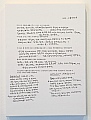
I attempt a response to a particular Catholic prayer that I have learnt to recite since my childhood.
Commonly referred to as Yondo, the prayer is intended for mourning the deceased and is often
recited at formal Catholic ceremonies and on anniversaries of the dead. This is a particular
phenomenon that results from the translation process of various passages of the Book of Psalm in the
Old Testament. Yondo is a hybrid text, for it contains many proper nouns of holy objects, locales such
as Jerusalem, and numerous names of saints in phonetic transliteration of Hebrew and Latin in
Korean, filtered through the lens of Confucian culture and worldviews. Moreover, it is a peculiar
example of crossbreed in its retention of archaic expressions of Korean, which has largely been lost
today. As such, Yondo is a montage of quotations culled from multiple languages and cultures. As a
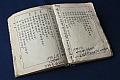
child, I found many of the phrases incomprehensible. As the prayer book was published many
decades ago, it features the conventional format of rare books from the pre-modern period. Thus there
is significant amplitude in the gap between the form and the content of Yondo. When chanted by a
group, a leader would recite the first half of each sentence, and the rest would respond and complete
the remainder of the sentence. Ironically, I used to chant Yondo as integral part of Confucian
ceremony (Chesa) for my ancestors.
The reason I represent Yondo as an artistic language is not merely due to my having once been a
former Christian or my interest in Catholicism per se, but rather stems from my recognition that Yondo
is akin to a kind of foreign language, or that it consists of multiple languages. After all, what seem so
foreign and distant are not only the Christian doctrines but also the archaic form of Korean language
in the global age, and as such they may be considered foreign languages. Further, their concoction
causes an effect of yet another foreign language of entirely different kind. In short, the aspects of
hybridity and heterogeneity that constitute Yondo are significant part of my consciousness. I am
questioning the baptism of such heterogeneity, which I routinely received as part of my mother tongue
since youthful age. The new work is a way of thinking about the location of my mother tongue through
Yondo, in its seeming seamlessness in organically weaving together the Confucian and Catholic
references.
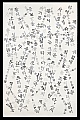
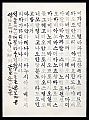
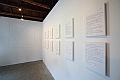
My watercolors and sound piece are thus an attempt to work through Yondo, to de-colonize the text by
refusing to be dictated, and to resist an assigned role of empty receptacle to receive the inscriptions of
Roman Catholicism, Confucianism and cultural imperialism. Interestingly, even through the process of
articulation and enunciation of the text my work reveals certain degree of reverence. However, my
enunciation of Yondo may be mimetic and phatic act but not necessarily rhetic one.
For me the ladies’ scarves (Misabo) worn during Catholic mass appear as a material embodiment of
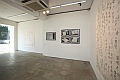
such concerns. The Misabo series are digital prints on canvas of the survey that I initiated by asking
randomly chosen female Christians to fill out the questionnaire. A few “correct” answers that I came to
learn through the survey refer to a specific biblical passage and implicate how language inhabits the
body. According to the Letters from the Corinthians, one may surmise that the supposedly original
intention for the ladies’ scarves has to do with suppression of both female desire to appear seductive
and the attendant male gaze.
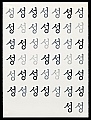
The works in the Intervals raise the question of how to exist as cultural crossbreeds in the conflict-
ridden world. Yondo and Misabo demonstrate that no linguistic or cultural self is a pure entity. They
challenge me to acknowledge that every language is foreign one, including my mother tongue. By
reconfiguring the hybrid and heterogeneous text in all of their complexities I question what it means to
live with ambivalence inherent in translation.